
The automobile is entering the recycled era. While Europe has just unveiled new rules imposing an increasing place for recycled materials in vehicles, Sumika Polymer Compounds Europe is taking a step ahead. With a new recycling unit in France and a range of recycled polypropylenes designed to meet the requirements of the automotive sector, the company is positioning itself as a key player in the circular mobility of tomorrow.
The main changes of the new regulations
The new European regulation on end-of-life vehicles marks a turning point for the entire automotive industry. Adopted by the Council of the European Union last June, the text introduces new requirements for the design, recycling and incorporation of recycled materials in new vehicles.
Among these measures, the regulation sets progressive targets for the integration of recycled plastics into new vehicles .
Europe is taking a decisive step towards the circular economy in the automotive industry: From 2032, at least 15% of the plastics used in new vehicles must come from recycling, a threshold that will rise to 25% in 2036. Some of these materials will have to come from end-of-life vehicles, thus promoting a real closed loop within the automotive industry.
These new requirements will profoundly reshape the entire value chain, from the eco-design of parts to their collection and recycling at the end of their life. They will apply to passenger cars, light commercial vehicles and several other categories of vehicles. The regulation also strengthens the traceability requirements of materials, provides a stricter framework for the export of untreated end-of-life vehicles and establishes a harmonised extended producer responsibility scheme at EU level.
A new recycling unit in France
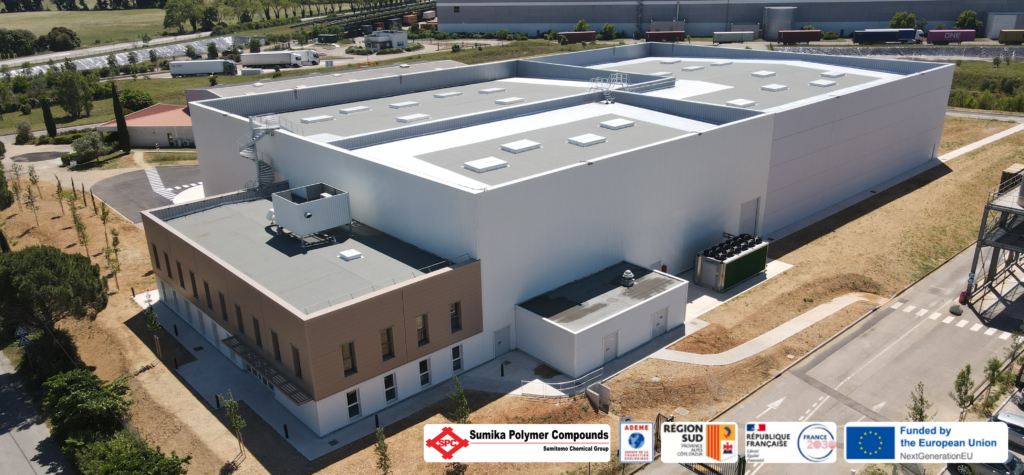
Sumika Polymer Compounds Europe has chosen to act today. Supported by the European Union, ADEME as part of France 2030, as well as by the Southern Region, the company is investing more than €13 million in a new mechanical recycling plant in France to support manufacturers and equipment suppliers in the growing integration of recycled materials into the vehicles of tomorrow.
With a production capacity of more than 10,000 tonnes of recycled polypropylene per year, this unit will recover industrial waste from the automotive sector and reintroduce it into new high value-added applications. It will thus contribute to the development of a true circular economy within the sector.
This new site complements the recycling plant already operated by the group in Turkey. Together, these two facilities will represent an annual capacity of more than 25,000 tons of recycled polypropylene, strengthening Sumika’s ability to meet the growing demand for high-performance recycled materials in Europe.
“This new plant illustrates our belief that regulatory compliance should not be seen as a constraint, but as an opportunity to build a more resilient, circular and competitive European automotive industry.” Bruno Pendélio, Head of Marketing & New Product Development Director, Sumika Polymer Compounds Europe
Sumika Polymer Compounds Europe’s new recycling plant in Saint-Martin-de-Crau (France), dedicated to the production of recycled polypropylene for automotive applications.
A “closed loop” approach for the automotive of tomorrow
This new plant is fully in line with Sumika Polymer Compounds Europe’s closed loop approach, which aims to transform automotive plastic waste into resources for new high value-added applications.
While the traditional automotive model is based on a linear logic (produce, use, throw away), the circular economy opens the way to a new approach. Thanks to a controlled collection of plastic waste and expertise in mechanical recycling, Sumika reintroduces these materials into the manufacture of new parts, thus reducing the dependence on virgin resources and the environmental footprint of vehicles.
The ambition is clear: to make end-of-life vehicles the raw materials for tomorrow’s vehicles, while helping manufacturers and suppliers to anticipate future European regulatory requirements.
This vision takes shape through Thermofil Circle, a range of recycled polypropylenes specially developed for automotive applications. Designed to meet the challenges of performance, circularity and regulatory compliance, it supports manufacturers in their projects integrating recycled materials.
Thermofil Circle offers:
- Mechanical performance for demanding automotive applications
- Secure supply based on a closed loop value chain
- Recovery by mechanical recycling of plastic waste
- A significant reduction in carbon footprint, up to 65% less CO₂ emissions compared to some reference virgin resins
- Sumika’s expertise in the formulation and recovery of recycled polymers
- A solution designed to meet the future requirements of the European End-of-Life Vehicle (ELV) Regulation
With its new recycling unit in France and its Thermofil Circle range, Sumika confirms its desire to support the transformation of the automotive industry towards a more circular, more resilient and more sustainable model. In addition to regulatory compliance, the company intends to contribute to making recycling a real lever of competitiveness for the European automotive industry.
